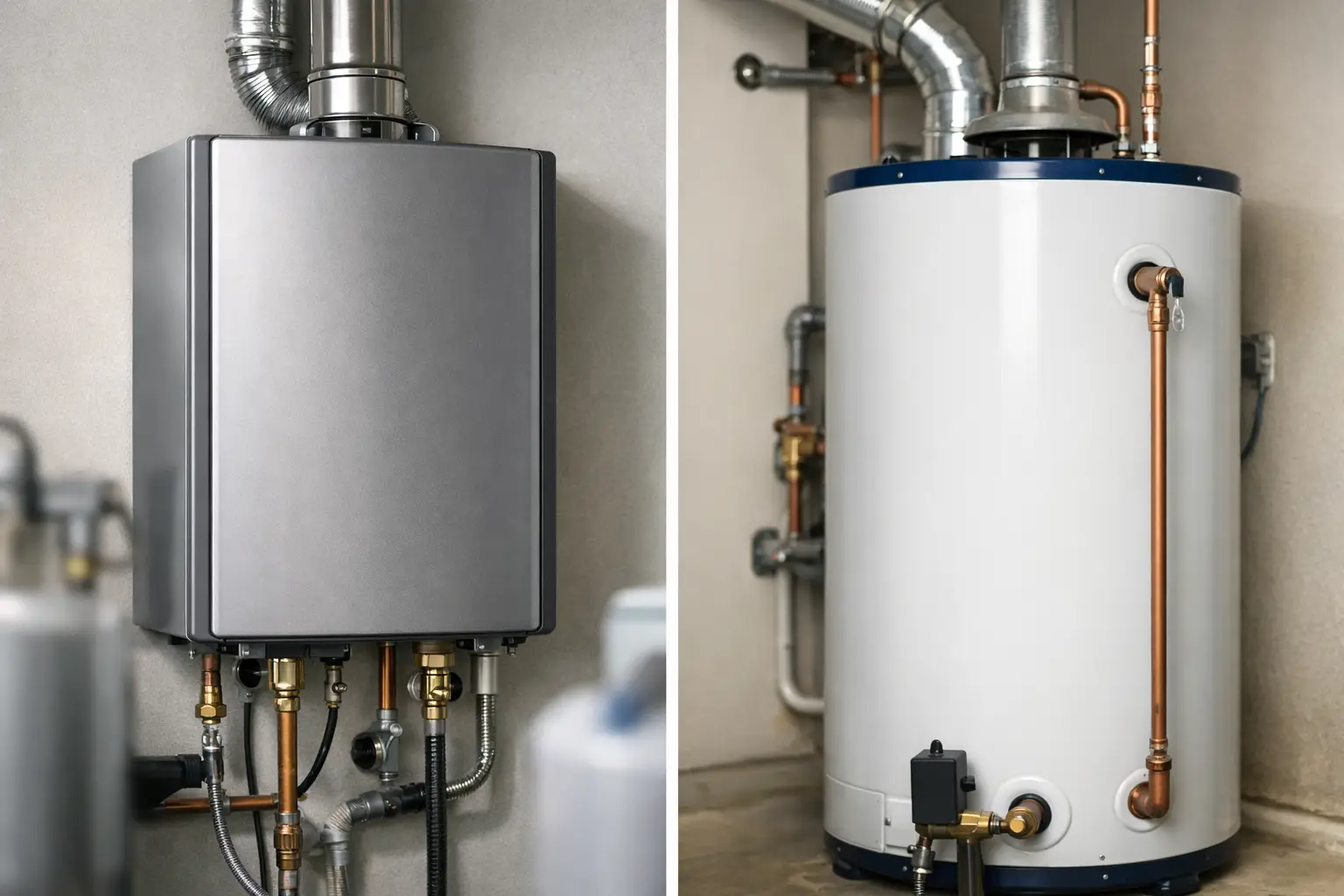
Tankless versus storage water heater: compare efficiency, hot water supply, space, maintenance, and gas setup to choose the right fit.
A water heater usually gets attention only when it starts running cold, leaking, or struggling to keep up with a busy property. When that happens, the tankless versus storage water heater question becomes less about trends and more about what will work safely, reliably, and realistically for your home or building.
For South Florida property owners, that choice matters even more than many people expect. Hot water demand can vary widely between a single-family home, a condo unit, a restaurant, or a multi-use commercial space. The right system depends on how the property is used, how often hot water is needed at the same time, and whether the gas infrastructure can support the installation properly.
A storage water heater keeps a set amount of water heated inside a tank, ready for use. When someone opens a hot water tap, that stored water is sent through the plumbing system. Once the tank is emptied, the unit needs time to heat a new batch of water.
A tankless water heater works differently. Instead of storing hot water, it heats water as it flows through the unit. That means you are not relying on a reserve inside a tank. You are relying on the unit’s ability to heat water fast enough to match demand in real time.
This difference shapes almost every practical decision that follows. Performance, energy use, space requirements, maintenance expectations, and gas line considerations all come back to this one point.
Storage units are often a practical fit for properties with predictable hot water patterns and moderate demand. If a household tends to use hot water in a fairly routine way, such as showers in the morning and dishwashing in the evening, a properly sized tank can do the job well.
Another reason some owners prefer storage systems is familiarity. These units are common, straightforward in concept, and easy for many customers to understand. If your current setup already supports a tank-style heater and the hot water demand has not changed much, replacing it with a similar style may be the more comfortable decision.
Storage heaters can also handle simultaneous use in a way that feels simple from the user side, as long as the tank size matches the property’s needs. If several fixtures are drawing from the same hot water supply, the tank provides a buffer. The limitation is that once that reserve is used up, recovery time becomes the issue.
That trade-off matters in larger households or properties with spikes in usage. A tank may perform well most of the time, then fall short when demand jumps all at once.
Tankless systems appeal to owners who want hot water on demand without depending on a storage tank. In many cases, the biggest advantage is continuity. If the unit is sized correctly and the flow demand stays within its capacity, hot water can keep coming without the same kind of depletion you get from an emptied tank.
That can be especially attractive in homes where multiple people shower at different times, or in commercial settings where hot water use happens throughout the day instead of in one or two concentrated periods. Tankless units are also popular where space is limited, since they do not require room for a large storage tank.
There is also the efficiency factor. Because a tankless unit does not keep a full tank heated around the clock, it can reduce standby energy loss. That sounds simple, but the real benefit depends on how the property uses hot water. A lightly used guest space may benefit differently than a busy family home or commercial kitchen.
Still, tankless is not automatically better. It has to be matched to the demand profile, and the gas service must be evaluated carefully.
The most common mistake in this decision is choosing based on label appeal instead of usage. The better question is not which system sounds newer or more efficient. It is how the property actually uses hot water.
A smaller home with limited simultaneous demand may do very well with either option. A larger household with back-to-back showers, laundry, and kitchen use may need a high-capacity tankless setup or may be better served by a properly sized storage system. A business property may need an even more specialized approach depending on fixtures, occupancy, and operating hours.
This is where professional guidance matters. Water heater performance is not only about the unit itself. It is also about gas supply, venting, fixture load, building layout, and installation conditions. For gas-powered equipment, those details need to be handled with safety and code compliance at the center of the project.
For many owners, this is the part that changes the conversation. A tankless gas water heater often requires a stronger gas supply than the old storage unit it is replacing. If the existing gas line was sized for a tank-style heater, it may not be adequate for a tankless installation.
That does not mean tankless is off the table. It means the gas system needs to be assessed correctly before a decision is made. Line sizing, appliance demand, venting configuration, and overall installation conditions all affect whether the upgrade is practical and safe.
In homes and commercial properties across Miami, older infrastructure or added gas appliances can complicate the picture. If a property already has a gas range, dryer, generator connection, or other gas equipment, the available capacity needs to be reviewed as part of the planning process.
This is one reason it helps to work with a company that specializes in gas service rather than treating the water heater as a simple swap.
Space is one of the clearest differences between these systems. Storage water heaters need a dedicated footprint for the tank. Tankless units are smaller and often wall-mounted, which can free up room in utility areas, closets, or service spaces.
Lifespan and maintenance are a little more nuanced. Tankless units are often viewed as a long-term option, but they require regular maintenance to perform well, particularly in areas where mineral buildup can affect components. Storage heaters also need maintenance, and tank failure remains a known concern over time.
The key point is that neither system is truly maintenance-free. Property owners should expect periodic service, inspection, and attention to performance. If reliability is the priority, maintenance should be part of the decision from the start, not an afterthought after installation.
Commercial properties rarely benefit from a one-size-fits-all answer. A small office with limited hot water use has different needs than a restaurant, salon, multifamily building, or retail space with customer-facing restrooms and back-of-house cleaning demand.
In some commercial settings, tankless can be an excellent fit because of its compact footprint and continuous heating capability. In others, a storage system or a more customized hot water setup may offer better consistency under heavy simultaneous use.
What matters most is proper evaluation. Commercial gas work needs careful planning, clear safety standards, and installation that supports the actual operations of the business. A rushed decision can create service interruptions, poor performance, or compliance concerns later.
If you are weighing tankless versus storage water heater options, start with usage, not brand preference or internet hype. Think about how many people use hot water, when demand peaks, whether multiple fixtures run together, and what kind of gas infrastructure the property already has.
Then look at the practical conditions around the installation. Does the property have enough room for a tank? Is space savings a real benefit? Will the gas line and venting support a tankless unit safely? Is the building residential, mixed-use, or commercial?
A good decision is usually the one that fits the property without forcing unnecessary compromises. The right water heater should deliver dependable hot water, support safe gas operation, and match the building’s day-to-day needs.
For property owners who want a safe and reliable answer, the best next step is a professional assessment of the site conditions and gas requirements before selecting equipment. That is especially true when converting from one system type to another.
If your current water heater is aging, underperforming, or no longer matches the way your property uses hot water, this is a good time to ask better questions before replacing it. The right choice is the one that works well not just on paper, but in real daily use.
In this article
Discuss Your Gas Project
Contact Prestige Gas Services for natural gas and propane service in Miami-Dade and Broward counties. Request a free estimate.