Learn how gas leak inspections work, what technicians check, which tools they use, and what happens next to keep your property safe and compliant.
A gas smell near an appliance, meter, or outdoor line gets your attention fast. In that moment, most property owners want the same thing – a clear answer about how gas leak inspections work, what a technician is actually checking, and what happens if a problem is found.
A professional gas leak inspection is designed to do two things at once: protect safety and identify the exact source of the issue. That may sound straightforward, but the process is more detailed than many people expect. Gas systems include multiple connection points, regulators, valves, shutoffs, appliance hookups, and piping runs. A proper inspection is not guesswork. It follows a methodical process built around safety, code awareness, and accurate testing.
The inspection usually begins with a conversation. A qualified technician will ask what you noticed, where you noticed it, and whether the smell has been constant or intermittent. They may also ask if any recent work was done on an appliance, a gas line, or around the meter. Those details matter because they help narrow down whether the issue is likely tied to a fitting, a connection, an aging section of pipe, or a specific appliance.
Before testing begins, the area is assessed for immediate hazards. If the odor is strong or conditions suggest an active leak, safety comes first. That can mean shutting off the gas supply to the affected area or isolating the system before further inspection. The goal is to reduce risk while still gathering enough information to diagnose the problem correctly.
Once the area is stable, the technician inspects the system visually. This step is often overlooked by property owners, but it is an important part of the job. Visible signs such as corrosion, damaged connectors, loose fittings, worn valve components, or questionable previous work can point to likely trouble spots. In residential settings, this may involve checking gas appliances like ranges, water heaters, dryers, or generators. In commercial settings, the inspection may also include larger distribution lines, multiple appliances, and more complex shutoff arrangements.
After the visual review, testing begins. Depending on the situation, a technician may use leak detection solution, pressure testing equipment, or specialized gas detection instruments to locate escaping gas. Each method serves a different purpose.
Leak detection solution is commonly used at joints and fittings. If gas is escaping at a connection, the solution forms bubbles that reveal the exact point of leakage. This is useful for accessible areas where a fitting or union is the suspected source.
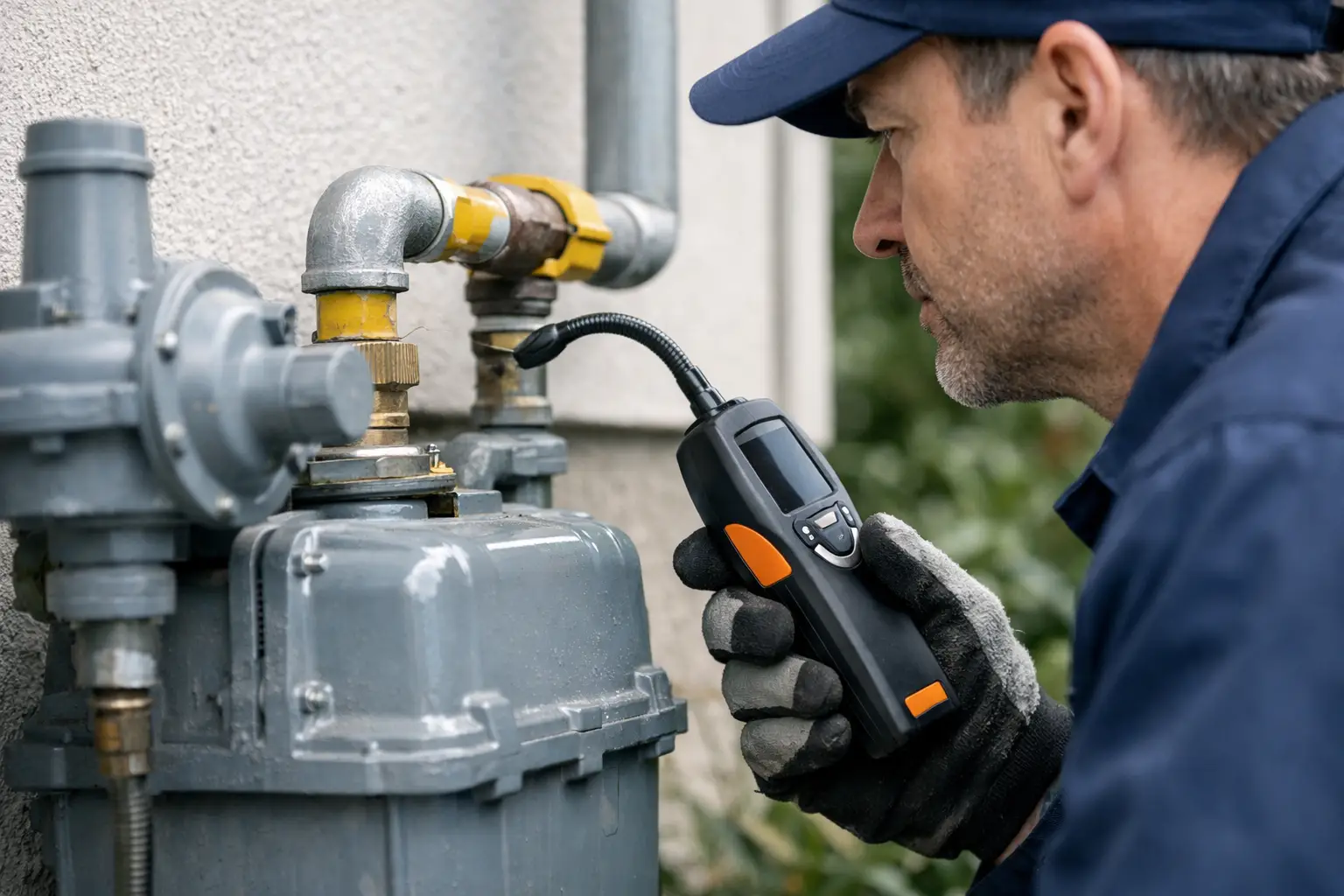
Electronic gas detectors help identify the presence of gas in the air, especially in places where the source is not immediately visible. These instruments can detect low concentrations and help trace gas movement around appliances, piping runs, and enclosed spaces. They are especially useful when an odor is noticeable but the leak is small or intermittent.
Pressure testing is often used when the problem is not isolated to a visible connection or when a section of the system needs to be evaluated more broadly. In simple terms, the system or a segment of it is tested to see whether it holds pressure as it should. If pressure drops, that indicates leakage somewhere within the line or connected components. This kind of test helps determine whether the issue is local or part of a larger system concern.
A thorough inspection does not stop at the place where the smell seems strongest. Gas can travel, and odors do not always stay close to the source. That is why trained technicians check the system in sections.
They typically start with the meter and service entry, then move through exposed gas piping, shutoff valves, regulators, unions, flex connectors, and appliance connections. If the property has outdoor equipment such as a pool heater, generator, or gas grill line, those components may also be included if they are part of the affected system.
Inside the property, technicians look at the condition of the piping and the way appliances are connected. A small issue at a connector behind a range can create a noticeable odor in an adjacent room. A valve that is not sealing properly may release a minor but still unsafe amount of gas over time. In older systems, corrosion or wear can become a factor. In newer systems, the issue may be tied to installation quality or movement at a connection point.
This is also where experience matters. Not every gas odor complaint turns out to be a major line failure, but not every minor smell should be dismissed either. Some leaks are obvious. Others only appear under certain operating conditions, such as when an appliance cycles on or when pressure changes within the system. A careful inspection accounts for those variables rather than assuming the first visible issue is the only one.
The basic process is consistent, but the details depend on the property and the system layout. A single-family home with one water heater and one range is very different from a commercial site with multiple appliances and longer gas piping runs. Access also changes the approach. Exposed piping is easier to inspect than sections routed through walls, ceilings, or utility spaces.
Local conditions can matter too. In South Florida, many property owners have outdoor gas equipment, standby generators, or gas systems exposed to humidity and weather. That does not automatically mean a leak is likely, but it does mean inspections should account for environmental wear, connection exposure, and the demands placed on the system over time.
Sometimes the inspection confirms a simple, isolated problem. In other cases, it reveals a broader issue such as aging infrastructure, multiple weak connection points, or noncompliant modifications from past work. That is why a qualified gas specialist focuses not just on finding gas, but on understanding the condition of the system as a whole.
If a leak is confirmed, the next step depends on the severity and location. In some cases, the affected section can be isolated immediately so the rest of the property remains safe while repairs are planned. In other cases, the gas supply may need to stay off until corrective work is completed and the system can be retested.
The technician should explain what was found in plain language. Property owners do not need a complicated technical lecture. They need to know where the issue is, why it matters, and what must happen next to restore safe operation. For homeowners, that clarity reduces stress. For property managers and business owners, it helps with decision-making and scheduling.
After repairs are completed, additional testing is typically performed to confirm the leak has been resolved and that the system is operating safely. This final verification is an important part of the process. A repair is not just about replacing a part or tightening a fitting. It is about confirming that the line holds properly, the connection is secure, and the system is safe to return to service.
The most common reason is a sulfur or rotten egg odor, but it is not the only one. Some customers call after installing or reconnecting an appliance. Others notice hissing near a line or meter. Property managers may request an inspection after tenant complaints, building maintenance, or utility work. Commercial operators often need inspections when expanding equipment, updating a kitchen, or addressing concerns before they become disruptions.
There are also cases where no strong odor is present, but something feels off. An appliance may not be operating normally, or there may be concern after storm activity, property damage, or changes to the gas system. In those situations, an inspection is less about reacting to an emergency and more about confirming that the system is safe and reliable.
Gas systems are not forgiving of shortcuts. A proper inspection requires the right tools, technical judgment, and a clear understanding of how gas piping and appliance connections behave under real operating conditions. It also requires a safety-first mindset. That is especially important for homes and businesses that rely on natural gas every day and need confidence that the system is compliant and dependable.
For customers in Miami and surrounding areas, working with a dedicated gas specialist can make the process simpler. Instead of dealing with uncertainty, you get a direct evaluation of the system, a clear explanation of the findings, and a practical path forward if repairs or corrections are needed.
If you suspect a gas leak, the most helpful next step is not to wait and hope it passes. Have the system inspected by a qualified professional who can identify the issue accurately and help restore safe operation with confidence.
In this article
Discuss Your Gas Project
Contact Prestige Gas Services for natural gas and propane service in Miami-Dade and Broward counties. Request a free estimate.