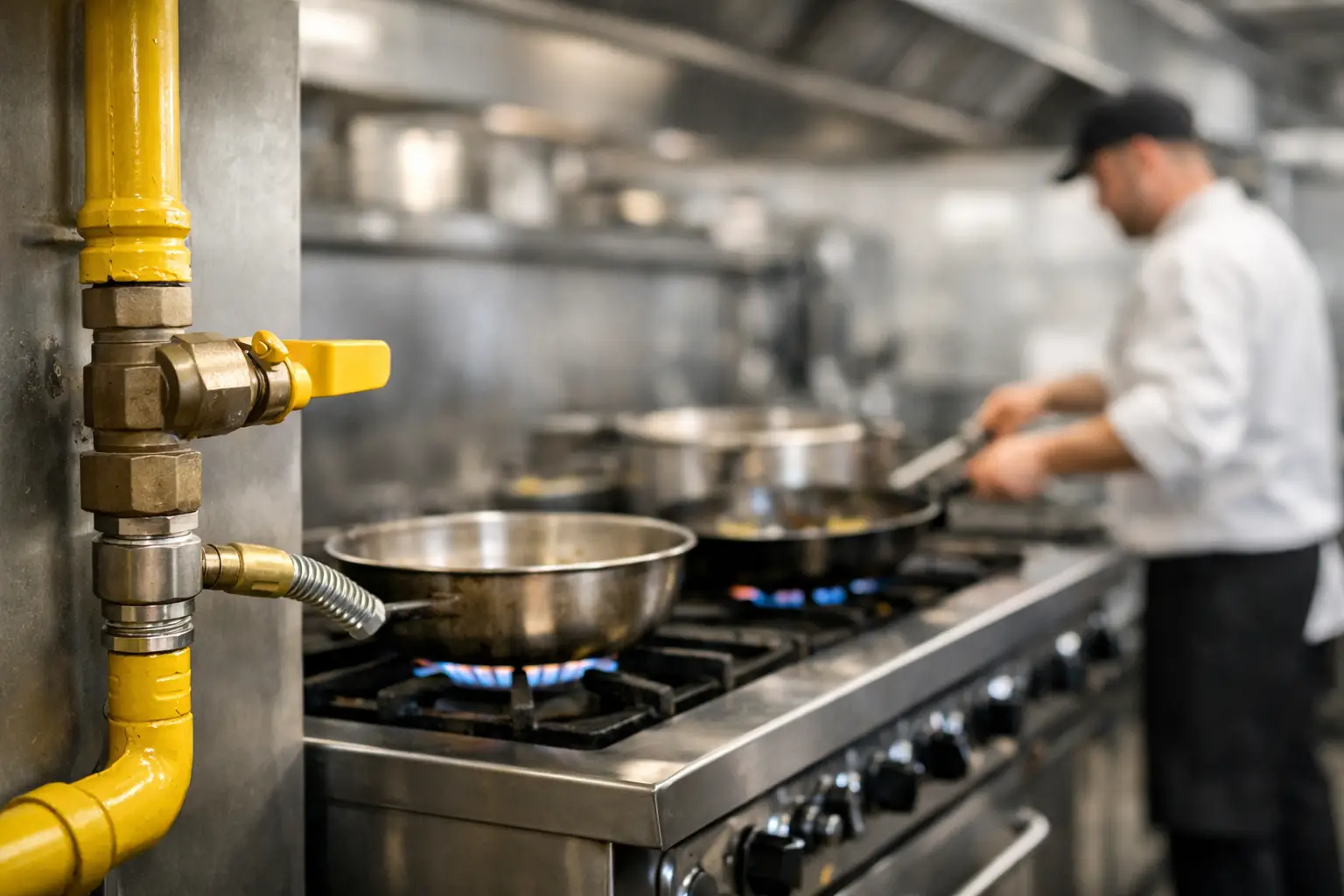
Use this commercial kitchen gas line guide to plan safe, code-compliant fuel piping, appliance connections, testing, and long-term restaurant operation.
A commercial kitchen can look ready for service long before its gas system is truly ready. The range may be in place, the hood may be installed, and the opening date may be approaching, but the gas line must still deliver the correct fuel supply safely, consistently, and in line with local requirements. This commercial kitchen gas line guide explains what business owners, property managers, and restaurant operators should understand before installation begins.
Gas piping is not a detail to leave until the end of a build-out. It affects equipment selection, kitchen layout, ventilation coordination, permit planning, and the reliability of daily operations. A properly planned system helps appliances perform as intended and gives your staff a safer working environment.
The first question is not simply where the gas line will run. It is how much gas the kitchen needs at full operating demand. Commercial equipment can include ranges, ovens, fryers, griddles, charbroilers, steam tables, water heaters, and make-up air units. Each appliance has a required BTU input, and the gas piping system must be sized to serve the combined demand.
A line that is too small can create low pressure at equipment during busy service periods. That may lead to weak burner performance, slow recovery times, ignition problems, or equipment that does not operate within the manufacturer’s specifications. Oversizing is not automatically the answer, either. The correct design depends on the appliance load, pipe material, pipe length, available supply pressure, fittings, elevation, and the type of gas being used.
Natural gas and propane systems are not interchangeable. Appliance ratings, regulators, orifices, piping calculations, and storage arrangements differ. Before any work is planned, confirm the fuel source available to the building and verify that every appliance is approved for that fuel type.
A new restaurant may begin with a limited menu and add equipment later. A catering kitchen may need greater capacity during seasonal demand. If expansion is likely, discuss it during the initial planning stage. In some cases, allowing for future capacity can reduce disruption when the kitchen grows.
That does not mean every project needs a large, complex system. A small cafe with a single range and water heater has different needs than a high-volume restaurant with multiple cooking lines. The goal is a practical system designed around the operation you are actually building.
A commercial gas line should support safe use and service access, not simply reach the appliances. Routing must account for walls, ceilings, appliance locations, traffic areas, heat exposure, and the need to inspect or service components over time. Gas piping should be protected from physical damage and installed according to applicable code requirements.
Equipment placement matters. A cooking line that appears efficient on a floor plan may create challenges if gas connections, shutoff valves, and flexible connectors cannot be accessed safely. Mobile equipment, such as ranges that move for cleaning, often requires an approved connection arrangement and a restraint system designed for the appliance.
Every gas-fired appliance generally needs an accessible shutoff valve. Staff should know where emergency shutoff controls are located and when to use them. Clear access becomes especially important during an equipment malfunction, suspected leak, or emergency response.
Gas piping also needs to work with the rest of the kitchen infrastructure. Hood systems, fire suppression systems, electrical service, plumbing, grease management, and HVAC all occupy valuable space. Coordination before installation prevents conflicts that can delay inspections or require costly layout changes later.
Gas appliances produce combustion byproducts and heat. Proper ventilation is essential for comfort, air quality, and safe kitchen operation. Depending on the equipment and kitchen design, the hood and make-up air system may need to be coordinated with gas controls and fire safety components.
For example, a fire suppression system may be designed to shut off fuel to certain cooking appliances when activated. This type of coordination should be planned by qualified professionals familiar with the complete commercial kitchen system. A gas line installation is only one part of a safe cooking environment.
Commercial gas work must meet applicable building, fuel gas, fire, and local jurisdiction requirements. In Miami and surrounding South Florida communities, permitting and inspection procedures can vary based on the property, scope of work, equipment, and local authority having jurisdiction.
Permits are not just paperwork. They provide a process for verifying that the system has been installed, tested, and reviewed according to required standards. For owners and property managers, this helps protect the business, supports future property transactions, and reduces the risk of discovering compliance issues after the kitchen is operating.
A qualified gas professional can help identify the documentation and coordination needed before work begins. This may include equipment specifications, gas load information, site plans, utility details, and approvals connected to the broader build-out. Early planning is usually easier than correcting an unapproved installation after walls, finishes, or equipment are in place.
A gas system should be pressure tested and inspected before it is placed into service, following the requirements that apply to the project. Testing verifies the integrity of the piping system and helps identify leaks before fuel is introduced to the equipment.
Once the system is approved and activated, appliances should be checked for proper operation. This includes confirming that each unit receives the required gas pressure, ignites correctly, and performs as expected. Regulators, valves, connections, and safety controls all deserve careful attention.
A professional commissioning process also gives the owner a chance to understand the system. You should know the location of key shutoffs, what equipment is connected to the line, and whom to contact if an issue arises. Keeping records of permits, inspections, equipment manuals, and service history can make future maintenance much simpler.
Not every concern means the entire gas system needs replacement. However, certain conditions should prompt a professional evaluation. Inconsistent burner flames, recurring ignition issues, equipment that struggles during peak use, visible corrosion, damaged connectors, or changes made to the cooking line can all affect gas performance and safety.
A gas odor, hissing sound near a connection, or suspected leak requires immediate action. Keep people away from the area, avoid creating sparks or operating electrical switches nearby, shut off the gas only if it is safe to do so, leave the building, and contact emergency services and the gas utility as appropriate. Do not return until the area has been cleared by the proper authorities.
Renovations also deserve attention. Replacing a small appliance with a higher-BTU model, adding another fryer, moving a range, or converting kitchen space can change the gas demand and connection requirements. What worked for the original layout may no longer be suitable.
Commercial kitchen gas work requires more than a basic appliance connection. Your provider should understand gas load calculations, pipe sizing, fuel-specific requirements, equipment connections, testing procedures, permit coordination, and the practical realities of keeping a business moving toward opening day.
Clear communication is equally valuable. Owners and managers need direct answers about what the project requires, what must be coordinated with other trades, and what steps come before inspection and activation. A dependable gas service provider should explain the work in plain language while maintaining a strict safety-first approach.
Prestige Gas Services Corp provides commercial gas installation support for businesses that need reliable natural gas solutions and responsive guidance. For a new kitchen, equipment upgrade, or concern with an existing gas line, an early project discussion can help prevent avoidable delays.
A commercial kitchen runs on timing, consistency, and safe equipment performance. Treat the gas system as a foundation of the operation, and involve a qualified professional before the first ticket reaches the kitchen.
In this article
Discuss Your Gas Project
Contact Prestige Gas Services for natural gas and propane service in Miami-Dade and Broward counties. Request a free estimate.