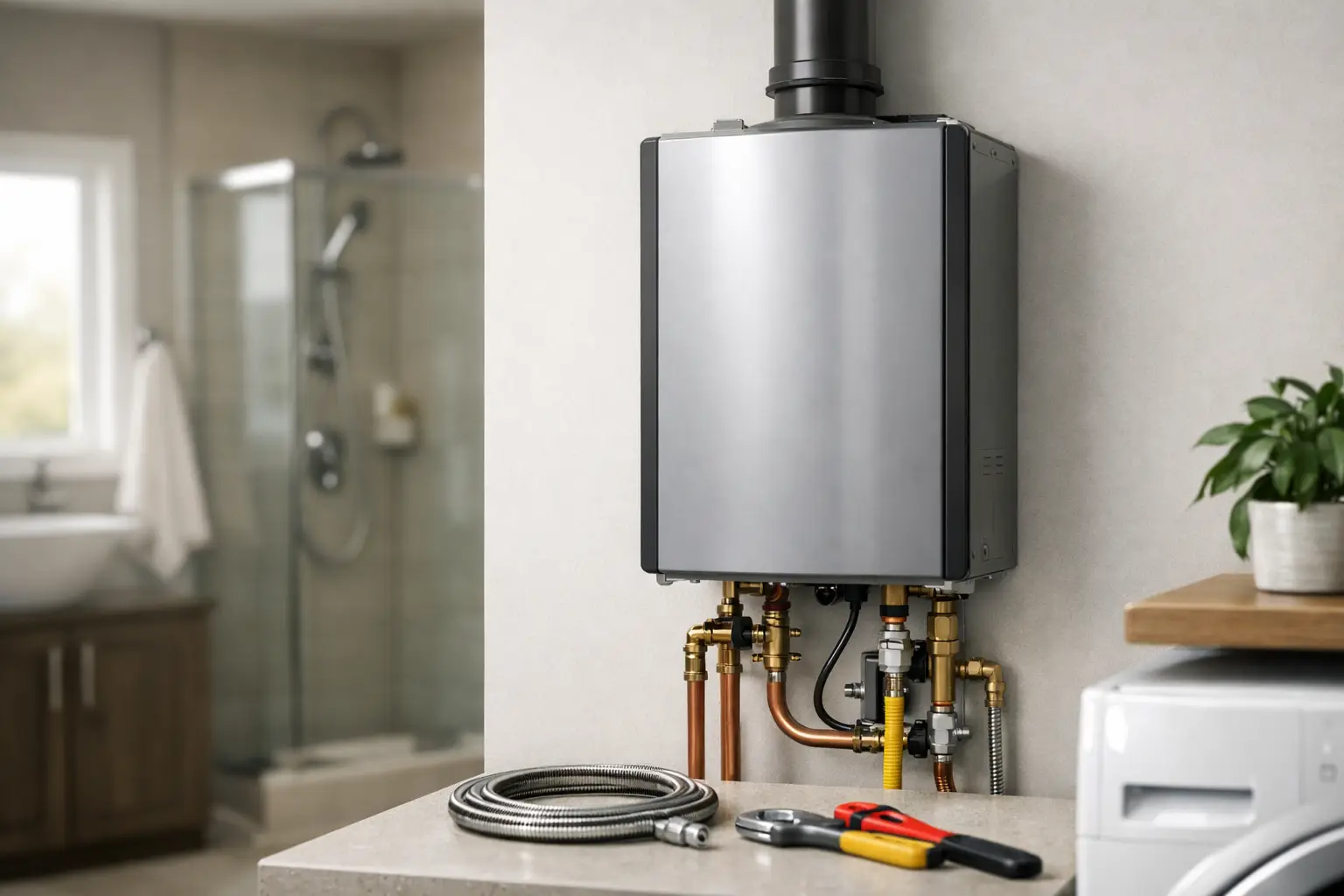
Rinnai tankless water heater guide for homeowners and property managers. Learn sizing, venting, gas needs, maintenance, and when to call a pro.
A tankless unit can solve one problem and create another if the selection is wrong. We see it often with homeowners who want endless hot water, only to learn later that gas capacity, venting, or fixture demand was underestimated. This Rinnai tankless water heater guide is built to help you ask the right questions before installation, so the system you choose is safe, reliable, and a good fit for the property.
Rinnai has a strong reputation in tankless water heating because the equipment is designed for consistent performance, compact installation, and high-demand use. For many homes and light commercial spaces, that matters more than marketing language. What people usually want is simple – dependable hot water, efficient operation, and a system that does not take up the footprint of a traditional storage tank.
That said, a Rinnai unit is not automatically the right answer for every building. Tankless performance depends on fuel supply, venting design, water demand, and installation quality. A well-matched unit can perform very well for years. A poorly matched one can lead to flow issues, ignition problems, temperature fluctuation, or unnecessary service calls.
The main decision is not just which model to buy. It is whether the property can support the unit correctly and whether the unit can meet real-world demand during peak use. In a typical household, that peak might be two showers running while the dishwasher or washing machine is on. In a commercial setting, demand can be less predictable and more concentrated.
That is why the conversation should start with usage, not just brand or efficiency claims. A larger family, a multi-bath home, or a property with high simultaneous hot water use may need a different setup than a smaller home with staggered usage patterns. In some cases, one properly sized unit works well. In others, a different configuration may make more sense.
One of the biggest misunderstandings with tankless equipment is the idea that home size determines the right unit. What matters more is how many fixtures may call for hot water at the same time and how much temperature rise the system must deliver.
If a household regularly runs multiple showers in the morning, the unit has to keep up with that demand without sacrificing temperature stability. If hot water use is spread out through the day, the required capacity may be lower than expected. This is where professional sizing matters. Guesswork tends to show up later as comfort complaints.
A Rinnai tankless unit needs adequate gas volume to operate properly. This is a critical point, especially in homes where multiple gas appliances already exist, such as ranges, dryers, furnaces, generators, or pool heaters. The water heater may be compact on the wall, but its gas demand can be significant.
If the gas line is undersized or the overall system was not evaluated, the appliance may not perform the way it should. This is not a detail to treat lightly. Safe, code-compliant gas work is part of what determines whether the installation supports long-term reliability.
Tankless equipment gives you more flexibility than a bulky tank, but that does not mean it can go just anywhere. Rinnai systems still require proper venting, approved clearances, and a suitable installation location. Indoor and outdoor models have different requirements, and local conditions should always be part of the discussion.
In South Florida, placement decisions also need to account for climate, exposure, and property layout. A location that looks convenient on paper may complicate vent routing or future service access. Good placement supports both safety and maintenance.
Some properties benefit from an outdoor unit because it can simplify venting and free up indoor utility space. Others are better served by an indoor model because of building design, access, or protection from environmental exposure. There is no one-size-fits-all answer.
The better approach is to evaluate the property first. A clean installation is not just about appearance. It should also support dependable performance, easier service, and compliance with current requirements.
Not every property needs the same type of tankless system. Rinnai offers both condensing and non-condensing models, and the differences affect venting, efficiency, drainage needs, and installation planning.
Condensing units are often attractive because of their higher efficiency and venting advantages, but they also require condensate management. Non-condensing units may fit certain replacement situations more easily, depending on the existing setup. The best option depends on the building conditions and what is needed to install the equipment correctly.
This is a good example of where the right choice is not always the one with the strongest headline feature. The right choice is the one that works safely, fits the property, and meets demand without creating avoidable installation complications.
A reliable installation starts with a practical review of the job. Before a Rinnai system is approved, it helps to know whether the gas service is sufficient, whether venting is straightforward, whether the unit location is appropriate, and how hot water demand actually looks during peak use.
For property managers, there is also the issue of consistency. A system that works well for one resident or tenant mix may not be ideal for another. In multifamily or mixed-use situations, usage patterns can shift. That is why planning should focus on actual operating conditions, not assumptions.
A strong installer should be able to explain the setup in plain language. If the explanation is vague, that is usually a warning sign. Safety-sensitive gas work should come with clarity, not confusion.
When customers are frustrated with tankless performance, the brand often gets blamed first. In reality, the issue is frequently tied to installation conditions. Undersized gas lines, improper venting, scaling from hard water, poor fixture matching, or unrealistic expectations about simultaneous demand can all affect results.
Cold-water sandwich complaints, fluctuating temperatures, or reduced performance over time do not always mean the equipment itself is defective. They often point to a sizing or system support issue that should have been addressed earlier. That is why experience matters when evaluating a tankless project.
Tankless systems are not maintenance-free. Over time, mineral buildup can affect efficiency and performance, especially in areas where water quality contributes to scaling. Routine maintenance helps protect the heat exchanger and keeps the unit operating as intended.
For owners, this is worth understanding upfront. Tankless technology can be a very good long-term solution, but it still needs proper care. A reliable service plan and clear maintenance expectations are part of responsible ownership.
Not always. If the building has limited gas capacity, difficult venting conditions, or unusual demand patterns, another approach may be better or the installation may require more planning than expected. That does not mean tankless is a poor option. It means the property has to be evaluated honestly.
For many homes, a Rinnai unit is a strong fit because it delivers consistent hot water without the bulk of tank storage. For some commercial users, it can also be a practical solution where space and performance both matter. But good results depend on proper sizing, correct gas planning, and installation that puts safety first.
In a market like Miami, where property types vary widely and gas work needs to be done correctly the first time, careful planning is not an extra step. It is the job.
If you are considering a Rinnai tankless system, the smartest next move is not to compare model numbers in isolation. It is to have the property evaluated by a qualified gas professional who can look at demand, gas supply, venting, and installation conditions together. That kind of upfront guidance usually saves time, avoids setbacks, and leads to a system you can count on.
In this article
Discuss Your Gas Project
Contact Prestige Gas Services for natural gas and propane service in Miami-Dade and Broward counties. Request a free estimate.